
How to Use Call Tracking Data to Train a Better Sales Team
- calltrack.ai
- No Comments
Most businesses invest heavily in sales training workshops, scripts, role-play sessions yet still struggle to improve conversion rates. The missing ingredient is often real data from real conversations. Call tracking doesn’t just tell you which ad drove a call; it gives you a window into what your sales team says once the phone rings. When you combine that intelligence with a structured training approach, performance improves measurably and fast.
CallTrack.ai’s call analytics platform captures every inbound interaction so managers can coach with evidence instead of guesswork. This article shows you exactly how to turn raw call data into a repeatable training system.
Why Traditional Sales Training Falls Short
Sales training typically relies on hypothetical scenarios. Trainers build scripts based on what they think customers say, not what customers actually say. The result is a team that’s rehearsed for situations that rarely occur while unprepared for objections that come up daily.
Call recordings flip this dynamic. Instead of simulating conversations, you analyze the real ones. Patterns emerge quickly: which objections kill deals, which openers build rapport, which questions accelerate decisions. Training built on these patterns is far more relevant and far easier for reps to absorb.
Build a Call Library from Your Best and Worst Calls
Start by tagging calls by outcome inside your call tracking dashboard. Label calls as converted, lost, or callback needed. Over four to six weeks you will accumulate enough examples to identify consistent patterns.
Use CallTrack.ai’s call reporting tools to filter by campaign source, call duration, and outcome. Calls that lasted under 60 seconds rarely convert; calls over three minutes almost always do. Duration alone is one of the most actionable early signals you can share with a new rep.
Curate a library of ten to fifteen annotated calls that illustrate specific skills: handling price objections, re-engaging hesitant callers, or transitioning from information to appointment booking. These become the cornerstone of every training session.
Score Calls Against a Clear Rubric
Subjective feedback is the enemy of improvement. If a manager tells a rep they sound “too aggressive” without objective evidence, the rep has no way to calibrate. A scoring rubric solves this.
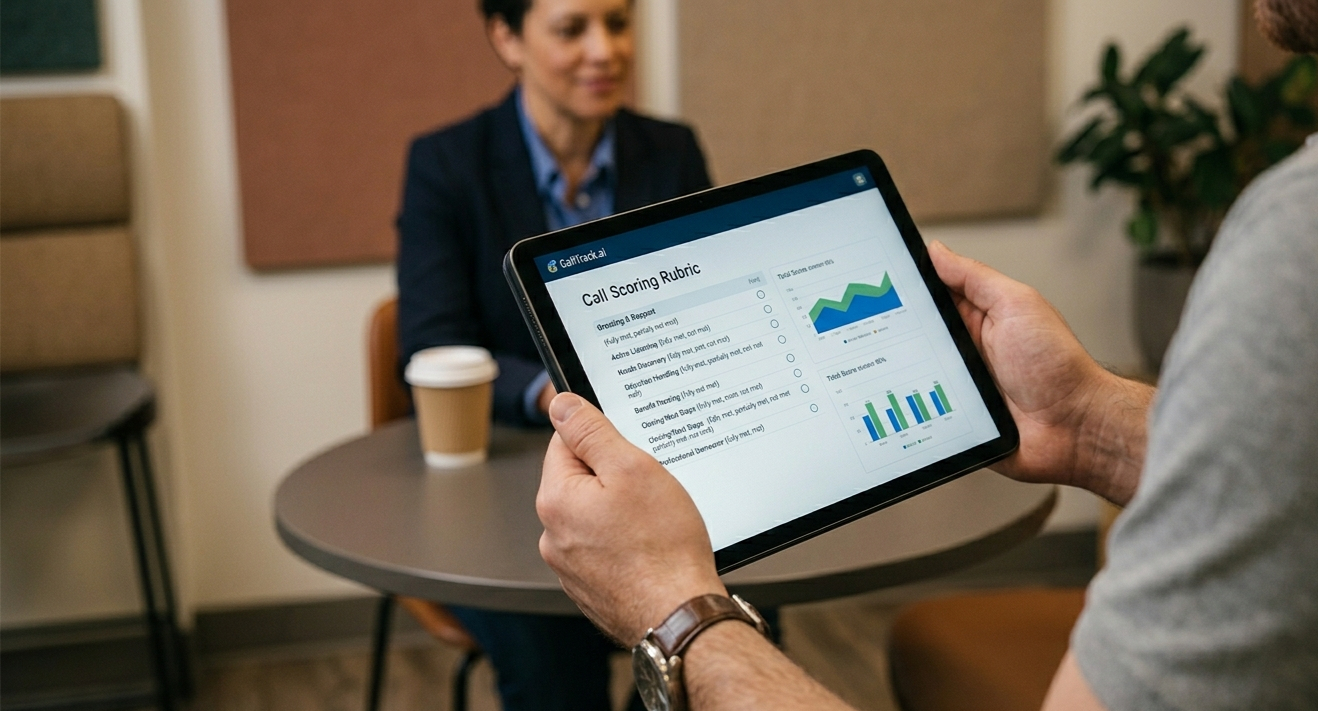
Build a rubric that measures five to seven behaviors per call. Examples include: greeting and caller identification, active listening signals, problem discovery questions, benefit framing, objection handling, and a clear close or next-step commitment. Score each behavior on a simple three-point scale: did not demonstrate, partially demonstrated, fully demonstrated.
Run the rubric on both your best performers and your average performers. The gap between the scores tells you exactly where to focus training effort. When the same rubric is applied to every recorded call, coaching conversations shift from opinion to observation.

Connect Call Source to Rep Performance
One underused capability of call tracking software is the ability to link the lead source to the call outcome. A caller who found you through a paid search ad is often further along in the buying process than a caller responding to a general brand awareness campaign. Training your team to adjust their approach based on call source can significantly lift conversion rates.
For example, callers from a retargeting campaign already know your brand. They need less education and more urgency. Callers from a generic keyword may need reassurance about fit before they are ready to move forward. When reps understand the intent behind a call before they pick up, every conversation starts in the right gear.
Run Weekly Micro-Coaching Sessions
Long training events are quickly forgotten. Research on skill retention consistently shows that short, frequent practice sessions produce better long-term improvement than occasional full-day workshops. Apply this principle to call coaching.
Each week, select two call recordings: one that illustrates a skill done well and one that illustrates a common miss. Share them with the team in a 20-minute session. Play the relevant segment, score it against the rubric together, and discuss what one specific adjustment would have changed the outcome. Keep sessions focused on a single skill at a time.
Over a quarter, this cadence means the team has examined and discussed 24 real calls. That is a powerful corpus of practical knowledge built entirely from their own customer interactions.
Measure Training Impact with Call Analytics
Training without measurement is just activity. Set clear benchmarks before you begin. If your current team converts 22 percent of inbound calls, set a 90-day target of 28 percent and track weekly movement toward that goal.
Use the AI IVR and call analytics features in CallTrack.ai to monitor conversion rate by rep, by campaign source, and by time of day. When you see a rep improving, review their recent calls to identify what changed. Codify those improvements and share them with the wider team. This creates a continuous feedback loop where your training program gets smarter every month.
Use Call Data to Identify Your Top Performers’ Hidden Habits
Every sales team has a rep who consistently outperforms the rest, and most managers have a vague sense of why they’re “natural” or “great with people.” Call tracking removes the mystery. When you run your top performer’s calls through the same rubric you apply to everyone else, specific, repeatable behaviors surface that explain the gap.
Common patterns you will find: they ask one more discovery question before pivoting to the pitch, they acknowledge the caller’s specific situation before presenting a solution, or they give a concrete next step with a time attached rather than a vague “I’ll follow up.” None of these habits are extraordinary. They are small, consistent differences that compound over hundreds of calls into significantly better conversion rates.
Use CallTrack.ai’s call analytics platform to pull a side-by-side comparison of your highest and lowest converters filtered by the same campaign source so you’re comparing like for like. Export the call duration, outcome, and any notes from 20 calls for each rep. Then listen for the moments where the conversations diverge. You will almost always find the fork in the road within the first three minutes of the call.
Once you have identified two or three high-performer habits, isolate them as standalone training modules. Teach one habit per week, demonstrate it with a real recording, and have reps practice it on a live call the following day. This turns your best rep into a force multiplier for the entire team without pulling them off the phones for hours of coaching duties.
Build a Pre-Call Intelligence Routine
Most sales reps answer the phone cold. They hear a voice, confirm a name, and improvise from there. Call tracking makes a better approach possible: a brief pre-call intelligence routine that gives reps context before they say a word.
When an inbound call arrives, your call tracking software can surface the caller’s source campaign, the keyword they searched, the pages they visited on your website, and whether they have called before. That information takes seconds to scan and fundamentally changes how a skilled rep opens the conversation. Instead of a generic greeting, they can acknowledge the caller’s likely context directly “I see you came in through our HVAC emergency service page, how can I help?” which immediately signals competence and relevance.
Build a one-page pre-call reference sheet for each major campaign source your business runs. List the top two reasons people call from that source, the most common objection, and the single most effective response to that objection based on your call recordings. Keep it visible at every workstation. Reps who use source-specific context in their opening 30 seconds consistently report that calls feel more natural and callers are more engaged from the start.
Combine this routine with CallTrack.ai’s call reporting to track whether pre-call context correlates with improved outcomes over a 60-day period. In most cases, it does not because the routine is complicated, but because it replaces the cognitive load of “who is this and what do they want” with a clear starting point that lets reps focus entirely on listening and responding.
Use Call Data to Identify Your Top Performers’ Hidden Habits
Every sales team has a rep who consistently outperforms the rest, and most managers have a vague sense of why they’re “natural” or “great with people.” Call tracking removes the mystery. When you run your top performer’s calls through the same rubric you apply to everyone else, specific, repeatable behaviors surface that explain the gap.
Common patterns you will find: they ask one more discovery question before pivoting to the pitch, they acknowledge the caller’s specific situation before presenting a solution, or they give a concrete next step with a time attached rather than a vague “I’ll follow up.” None of these habits are extraordinary. They are small, consistent differences that compound over hundreds of calls into significantly better conversion rates.
Use CallTrack.ai’s call analytics platform to pull a side-by-side comparison of your highest and lowest converters filtered by the same campaign source so you’re comparing like for like. Export the call duration, outcome, and any notes from 20 calls for each rep. Then listen for the moments where the conversations diverge. You will almost always find the fork in the road within the first three minutes of the call.
Once you have identified two or three high-performer habits, isolate them as standalone training modules. Teach one habit per week, demonstrate it with a real recording, and have reps practice it on a live call the following day. This turns your best rep into a force multiplier for the entire team without pulling them off the phones for hours of coaching duties.
Build a Pre-Call Intelligence Routine
Most sales reps answer the phone cold. They hear a voice, confirm a name, and improvise from there. Call tracking makes a better approach possible: a brief pre-call intelligence routine that gives reps context before they say a word.
When an inbound call arrives, your call tracking software can surface the caller’s source campaign, the keyword they searched, the pages they visited on your website, and whether they have called before. That information takes seconds to scan and fundamentally changes how a skilled rep opens the conversation. Instead of a generic greeting, they can acknowledge the caller’s likely context directly “I see you came in through our HVAC emergency service page, how can I help?” which immediately signals competence and relevance.
Build a one-page pre-call reference sheet for each major campaign source your business runs. List the top two reasons people call from that source, the most common objection, and the single most effective response to that objection based on your call recordings. Keep it visible at every workstation. Reps who use source-specific context in their opening 30 seconds consistently report that calls feel more natural and callers are more engaged from the start.
Combine this routine with CallTrack.ai’s call reporting to track whether pre-call context correlates with improved outcomes over a 60-day period. In most cases, it does not because the routine is complicated, but because it replaces the cognitive load of “who is this and what do they want” with a clear starting point that lets reps focus entirely on listening and responding.
Frequently Asked Questions
How many calls do I need before I can start identifying training patterns?
Most businesses find meaningful patterns after reviewing 30 to 50 calls. If your call volume is low, two to three weeks of recordings is usually sufficient to identify the top three objections your team faces.
Can call tracking data help onboard new sales reps faster?
Absolutely. New reps who listen to 10 annotated calls before their first live shift outperform those who go straight to the phones. A curated call library is one of the most effective onboarding tools available.
Should I tell callers their calls are being recorded?
Yes, and most jurisdictions legally require it. A brief statement at the start of the call which CallTrack.ai can automate through its IVR system keeps you compliant and rarely affects caller behavior in practice.
How do I handle reps who resist listening to their own recorded calls?
Frame it as a competitive advantage rather than surveillance. Reps who regularly review their calls improve faster than those who do not. Sharing examples of top performers using call review often shifts the mindset quickly.
Is there a performance difference between reps who handle calls from different marketing channels?
Yes, often significant. Reps who understand the intent difference between a paid search lead and an organic referral consistently outperform those who treat every call the same. Channel-specific coaching is one of the highest-leverage training investments you can make.
Stop guessing which ads drive sales and start scaling your ROI with intelligent data. Transform your marketing performance today with CallTrack.ai or contact us to learn more.